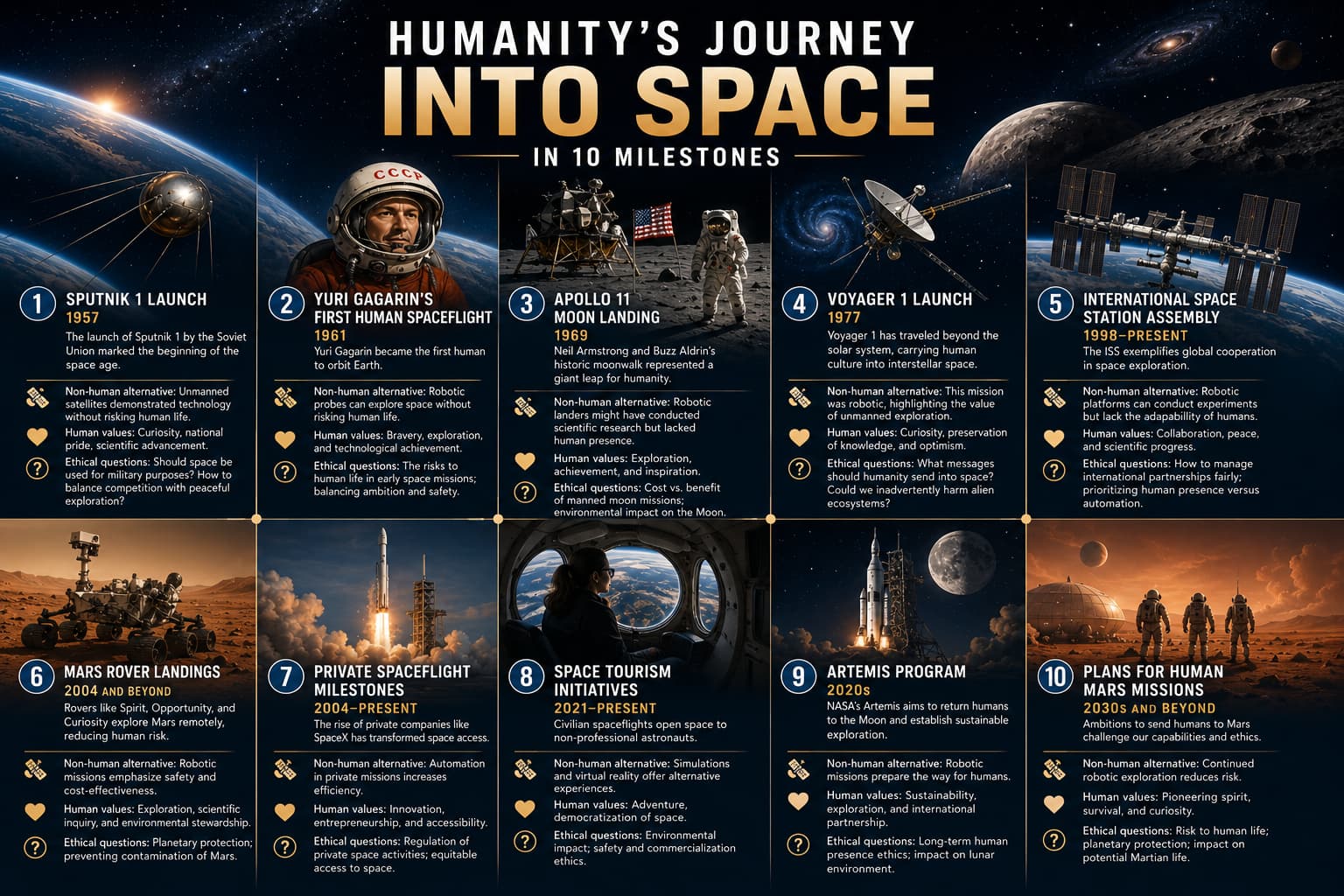
Humanity’s journey into space has been marked by remarkable milestones, each reflecting our curiosity, values, and ethical considerations. Below are ten historical moments in human space exploration, accompanied by discussions on non-human alternatives, human values, ethical questions, and relevant images.
Humanity’s journey into space began with Yuri Gagarin’s historic flight in 1961, marking the first time a human ventured beyond Earth’s atmosphere. This pioneering mission paved the way for future space exploration and demonstrated the incredible potential of human ingenuity and courage.
These milestones collectively illustrate the complex interplay between technology, human values, and ethical considerations in our quest to explore space.
Sputnik 1 Launch (1957)
The Soviet Union’s launch of Sputnik 1 marked the beginning of the space age. This milestone raised questions about the militarization of space and the ethical implications of space competition versus cooperation.
Non-human alternatives: Early satellites were unmanned, demonstrating technology without risking human life.
Human values: Curiosity, national pride, and scientific advancement.
Ethical questions: Should space be used for military purposes? How to balance competition with peaceful exploration?
Yuri Gagarin’s First Human Spaceflight (1961)
Yuri Gagarin became the first human to orbit Earth, symbolizing human courage and the desire to explore beyond our planet.
Non-human alternatives: Robotic probes can explore space without risking human life.
Human values: Bravery, exploration, and technological achievement.
Ethical questions: The risks to human life in early space missions; balancing ambition and safety.
Apollo 11 Moon Landing (1969)
Neil Armstrong and Buzz Aldrin’s historic moonwalk represented a giant leap for humanity.
Non-human alternatives: Robotic landers might have conducted scientific research but lacked human presence.
Human values: Exploration, achievement, and inspiration.
Ethical questions: Cost vs. benefit of manned moon missions; environmental impact on the Moon.
Voyager 1 Launch (1977)
Voyager 1 has traveled beyond the solar system, carrying human culture into interstellar space.
Non-human alternatives: This mission was robotic, highlighting the value of unmanned exploration.
Human values: Curiosity, preservation of knowledge, and optimism.
Ethical questions: What messages should humanity send into space? Could we inadvertently harm alien ecosystems?
International Space Station Assembly (1998-present)
The ISS exemplifies global cooperation in space exploration.
Non-human alternatives: Robotic platforms can conduct experiments but lack human adaptability.
Human values: Collaboration, peace, and scientific progress.
Ethical questions: How to manage international partnerships fairly; prioritizing human presence versus automation.
Mars Rover Landings (2004 and beyond)
Rovers like Spirit, Opportunity, and Curiosity explore Mars remotely, reducing human risk.
Non-human alternatives: Robotic missions that emphasize safety and cost-effectiveness.
Human values: Exploration, scientific inquiry, and environmental stewardship.
Ethical questions: Planetary protection; preventing contamination of Mars.
Private Spaceflight Milestones (2004-present)
The rise of private companies like SpaceX has transformed access to space.
Non-human alternatives: Automation in private missions increases efficiency.
Human values: Innovation, entrepreneurship, and accessibility.
Ethical questions: Regulation of private space activities; equitable access to space.
Space Tourism Initiatives (2021-present)
Civilian spaceflights open space to non-professional astronauts.
Non-human alternatives: Simulations and virtual reality offer alternative experiences.
Human values: Adventure, democratization of space.
Ethical questions: Environmental impact; safety and commercialization ethics.
Artemis Program (2020s)
NASA’s Artemis aims to return humans to the Moon and establish sustainable exploration.
Non-human alternatives: Robotic missions prepare the way for humans.
Human values: Sustainability, exploration, and international partnership.
Ethical questions: Long-term human presence ethics; impact on lunar environment.
Plans for Human Mars Missions (2030s and beyond)
Ambitions to send humans to Mars challenge our capabilities and ethics.
Non-human alternatives: Continued robotic exploration reduces risk.
Human values: Pioneering spirit, survival, and curiosity.
Ethical questions: Risk to human life; planetary protection; impact on potential Martian life.