Lunaria: The Moon Nation of Tomorrow
Introduction
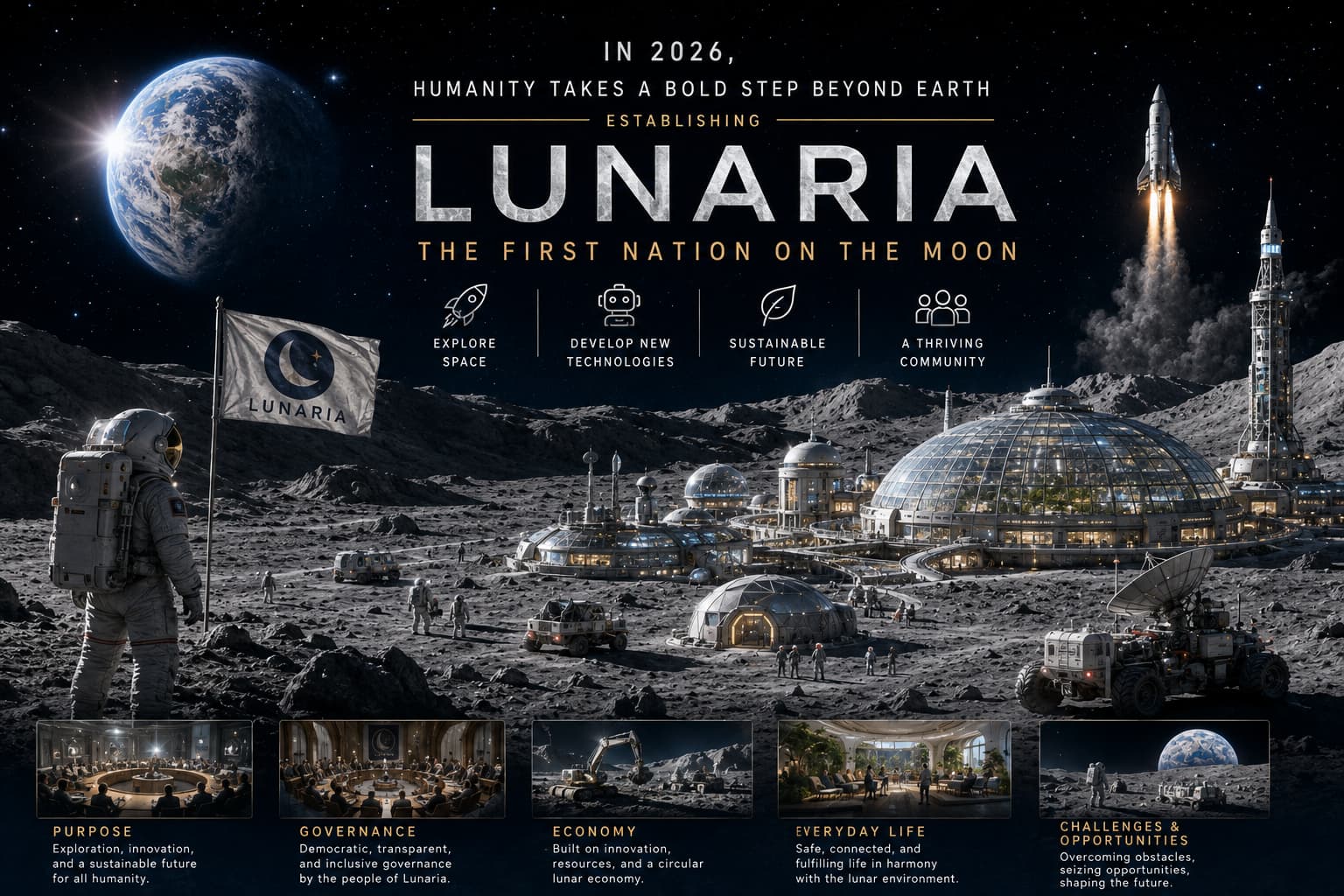
In 2026, humanity takes a bold step beyond Earth by establishing Lunaria—the first nation on the Moon. Lunaria is a pioneering society designed to explore space, develop new technologies, and create a sustainable, thriving community in the lunar environment. This document outlines Lunaria’s purpose, ownership, governance, economy, and everyday life, along with its main challenges and opportunities.
Purpose of Lunaria
Lunaria’s primary purpose is threefold:
- Scientific Research: To advance human knowledge about lunar geology, space sciences, and the effects of living in low gravity.
- Technological Innovation: To develop new technologies for space travel, renewable energy, and life support systems.
- Human Settlement: To establish a permanent human presence beyond Earth, serving as a model for future space colonization.
Ownership
Lunaria is founded as an international cooperative, owned collectively by participating countries, private companies, and scientific organizations. The Moon Treaty of 2025 established that no nation can claim sovereignty over the Moon, so Lunaria operates under a shared governance model respecting international space law.
Governance
Lunaria’s government is a democratic republic with the following structure:
- Council of Representatives: Elected by Lunaria’s citizens every two years, representing different lunar settlements.
- Executive Leader (Lunar President): Elected by the Council to implement policies.
- Scientific Advisory Board: A group of experts advising on research priorities and environmental protection.
- Judicial Committee: Resolves disputes and ensures laws comply with international agreements.
The legal system balances Earth laws and space-specific regulations. Participation in governance requires citizenship, which residents earn by living on Lunaria for at least one year and contributing to the community.
Economy
Lunaria’s economy is a mix of scientific funding, private enterprise, and resource utilization:
- Scientific Grants: Provided by Earth-based governments and organizations.
- Mining: Extraction of valuable minerals like Helium-3, essential for future clean energy on Earth.
- Manufacturing: Using lunar materials to create tools and building parts reduces dependence on Earth supplies.
- Tourism: Space enthusiasts pay high fees to visit temporary lunar hotels.
- Technology Development: Startups focus on robotics, environmental systems, and space agriculture.
Money is digital, based on a blockchain system to ensure transparency and security.
Everyday Life
Residents live in specially designed habitats with artificial gravity, life support, and radiation shielding. Life on Lunaria blends work, research, education, and recreation.
- Housing: Modular, expandable domes with gardens and common areas.
- Food: Mostly grown in hydroponic greenhouses using recycled water.
- Education: Virtual classrooms connect children with Earth’s schools, alongside hands-on lunar science lessons.
- Health: Medical facilities are equipped with advanced telemedicine systems supported by specialists on Earth.
- Recreation: Zero-gravity sports, moonwalks, and virtual reality experiences keep residents active and entertained.
Community events celebrate Earth holidays and lunar milestones, fostering cultural exchange and unity.
Main Challenges
- Radiation Exposure: The Moon lacks a magnetic field. Protective habitats and suits are essential.
- Resource Scarcity: Water and air must be recycled or imported until in-situ resources can be used.
- Psychological Effects: Isolation and confinement require strong social support and mental health services.
- Cost: High expense of transporting materials and people from Earth.
- Legal Issues: Navigating international space law and property rights.
Opportunities
- Scientific Breakthroughs: New discoveries in astronomy, geology, and biology.
- Clean Energy: Helium-3 mining could revolutionize Earth’s energy supply.
- Space Economy: Creating jobs and markets beyond Earth.
- Inspiration: Encouraging STEM education and international cooperation.
- Sustainability Model: Developing closed-loop life systems useful on Earth.
Time Frame (From 2026)
- 2026-2030: Establishment of initial lunar base, infrastructure development, and first settlers arrive.
- 2030-2040: Expansion of habitats, beginning of mining operations, growth of local economy.
- 2040-2050: Permanent settlements with diverse communities, lunar governance fully operational.
- 2050+: Lunaria becomes a self-sustaining nation and a hub for further space exploration.
References
- United Nations Office for Outer Space Affairs. (2025). The Moon Treaty.
- NASA. (2023). Artemis Program Updates.
- European Space Agency. (2024). Lunar Science and Exploration.
- International Space University. (2022). Space Settlement Governance Models.
- Space Foundation. (2023). Space Economy Report.
Multiple Choice Quiz
- What is the main purpose of Lunaria?
- A) To colonize Mars
- B) To develop a permanent human presence on the Moon
- C) To mine gold on the Moon
- D) To build a space hotel only
Answer: B
Explanation: Lunaria aims to establish a permanent human presence on the Moon for research, innovation, and settlement.
- Who owns Lunaria?
- A) A single country
- B) Private companies only
- C) An international cooperative
- D) The United Nations exclusively
Answer: C
Explanation: Ownership is shared internationally, in accordance with space law.
- How is Lunaria governed?
- A) By a single leader who rules for life
- B) By an elected Council of Representatives and a Lunar President
- C) By Earth’s governments directly
- D) By a group of scientists only
Answer: B
Explanation: Lunaria has a democratic republic system with elected representatives.
- Which valuable resource is mined on the Moon that could benefit Earth?
- A) Oil
- B) Helium-3
- C) Coal
- D) Uranium
Answer: B
Explanation: Helium-3 is a potential fuel for clean nuclear fusion energy.
- What is a major challenge for living on the Moon?
- A) Too much oxygen
- B) Lack of sunlight
- C) Radiation exposure
- D) Excessive gravity
Answer: C
Explanation: The Moon has high radiation levels because it lacks an atmosphere and a magnetic field.
- How do residents of Lunaria grow food?
- A) Traditional soil-based farming
- B) Hydroponic greenhouses
- C) Importing all food from Earth
- D) Hunting lunar animals
Answer: B
Explanation: Hydroponics allows plants to grow without soil using nutrient solutions.
- When are citizens eligible to participate in Lunaria’s governance?
- A) Immediately upon arrival
- B) After living there for one year and contributing to the community
- C) Only if born on the Moon
- D) After 10 years of residency
Answer: B
Explanation: Citizenship requires a period of residence and involvement.
- What type of currency does Lunaria use?
- A) Lunar coins made from moon rocks
- B) Earth dollars only
- C) Digital, blockchain-based currency
- D) Barter system only
Answer: C
Explanation: A blockchain digital currency ensures transparency and security.
- Which of the following is NOT an opportunity for Lunaria?
- A) Scientific breakthroughs
- B) Developing space tourism
- C) Unlimited natural resources
- D) Inspiring STEM education
Answer: C
Explanation: Resources are limited and must be carefully managed.
- What is the expected time frame for Lunaria to become self-sustaining?
- A) 2026-2030
- B) 2030-2040
- C) 2040-2050
- D) After 2050
Answer: D
Explanation: Full self-sustainability is projected after 2050.
Images (Descriptions)
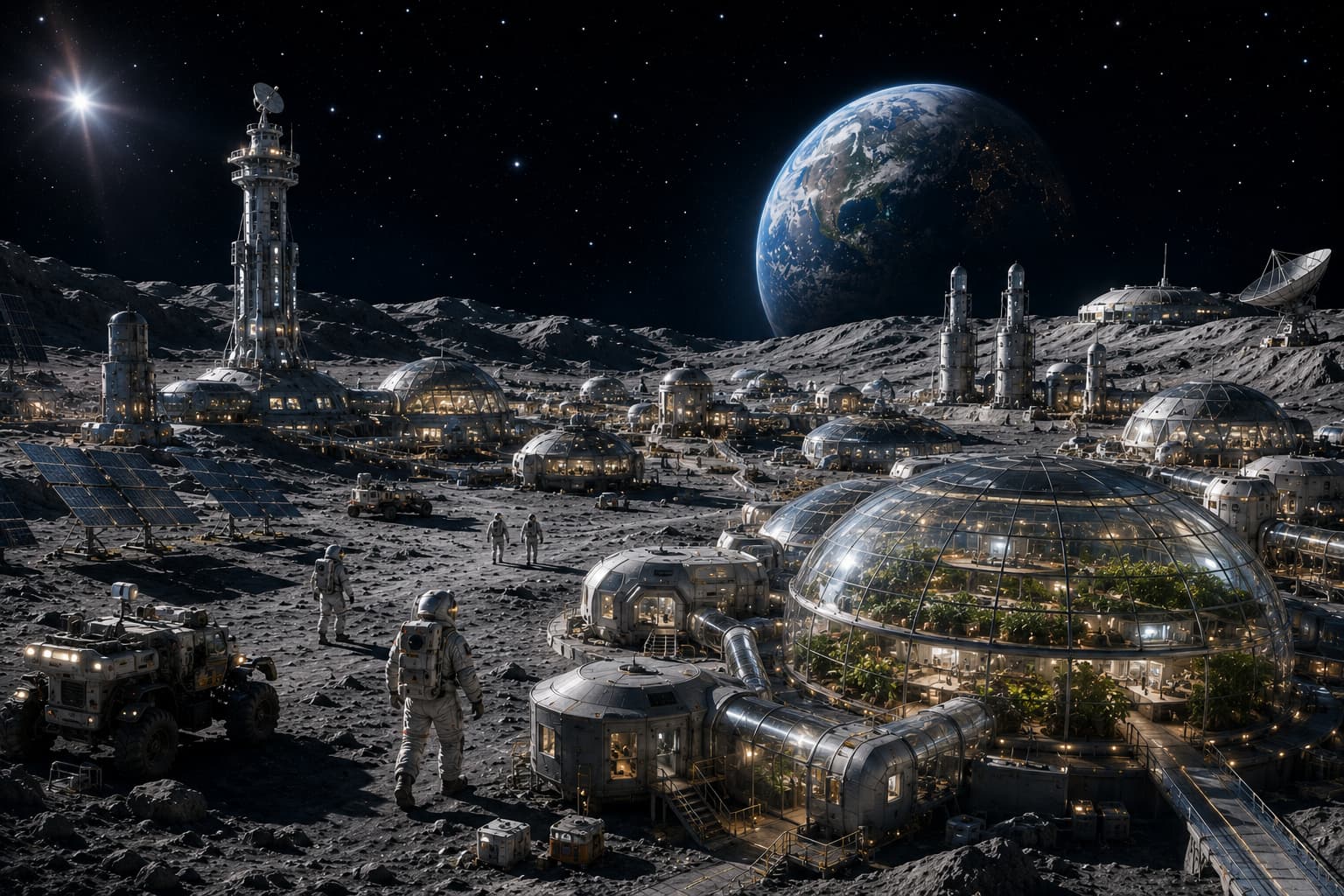
- Lunar Habitat Dome: A modular, transparent dome with solar panels and greenhouses inside, showing residents walking in low gravity.
- Helium-3 Mining Rover: A robotic rover extracting Helium-3 from lunar soil.
- Lunar City Layout: A map showing interconnected domes, solar arrays, and launchpads.
- Lunar President Addressing Citizens: A virtual meeting with Earth and Moon participants.
Lunaria represents humanity’s exciting future, combining science, cooperation, and adventure on the Moon. It challenges us to rethink life beyond Earth and offers a glimpse of the next giant leap for mankind.